To choose the right gate motor, start with your gate type (sliding or swing), then match the motor to the gate's weight and length, how many times a day it opens (duty cycle) and whether it needs battery backup for power outages. A correctly sized motor on a well-installed gate will run smoothly for years; an undersized one strains, overheats and burns out.
Most gate motor problems we hear about are not bad luck. A motor rated for a light residential gate gets fitted to a heavy steel gate, or a sliding gate runs on a bent rail with no proper foundation. This guide walks you through the decisions that matter before you buy.
Sliding vs swing gate motors: which do you need?
The first choice is usually made by your gate and driveway, not by preference.
Sliding gate motors
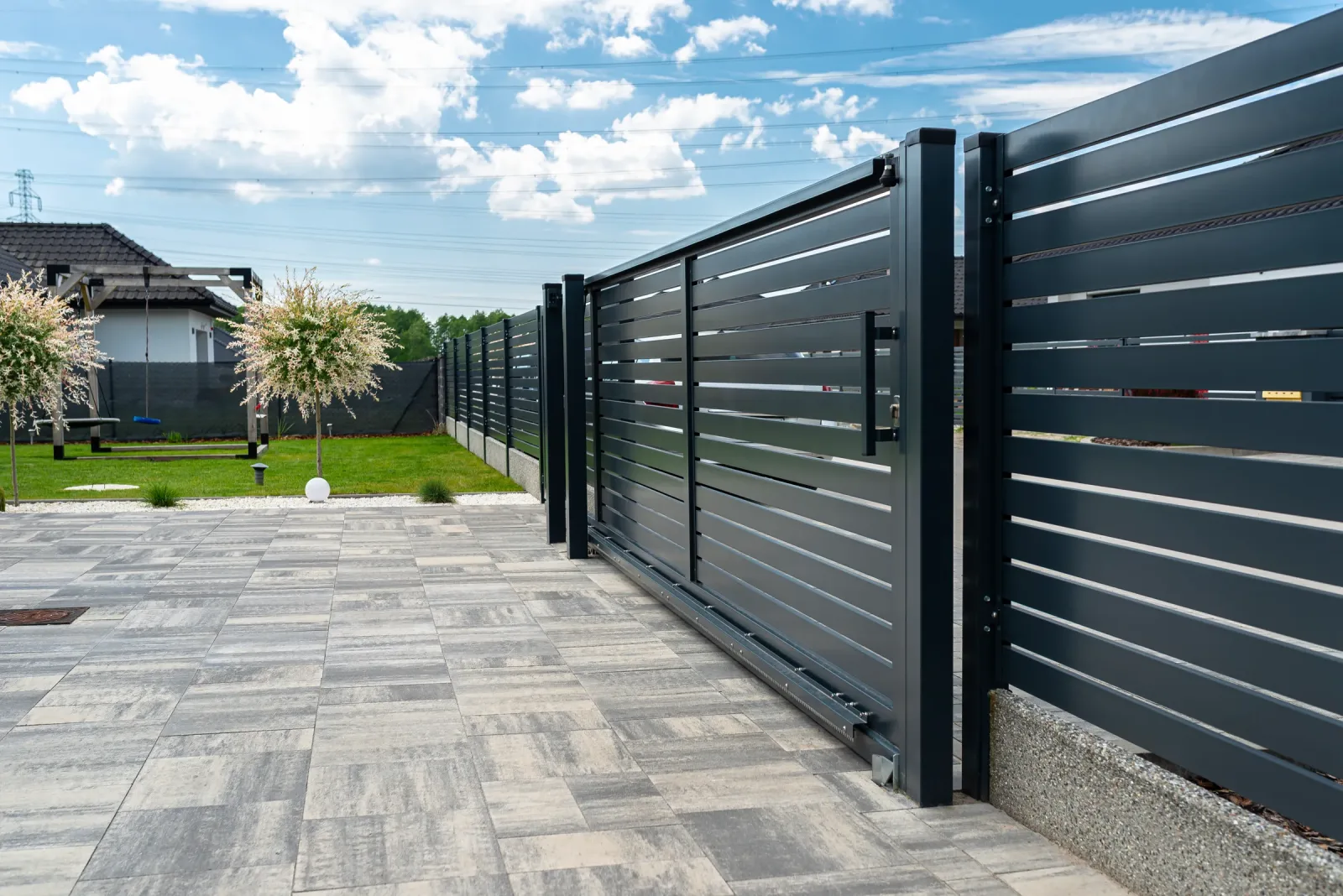
A sliding gate moves sideways along a rail and needs clear wall space beside the opening. The motor sits on a concrete plinth and drives the gate through a gear rack fixed along its length.
- Good for heavy gates and wide openings
- Ideal where the driveway slopes or there is little space to swing inwards
- Less affected by wind than swing gates
- Needs a straight, level rail and a solid foundation
Swing gate motors
A swing gate opens like a door on hinges. It is driven by arms (linear or articulated) or by underground motors, usually one per leaf.
- Suits double-leaf gates and openings without side wall space
- Needs clear space for the leaves to open, inward or outward
- Strong hinges and sturdy pillars are essential
- Large solid leaves catch wind, which adds load on the motor
If you are building a new gate, discuss motorisation with your fabricator early. A gate designed for a motor from the start is far easier to automate well.
Match the gate motor to weight and length
Every gate motor has a maximum gate weight (for sliding motors) or leaf weight and length (for swing motors). Treat these figures as limits, not targets. Choose a motor rated comfortably above your gate's actual weight.
- Estimate weight honestly. Solid steel sheet gates common in Kenyan homes are much heavier than open palisade designs.
- Check length. Long swing leaves put more strain on the arm and hinges, even if they are light.
- Consider friction. A sliding gate on worn wheels or a dirty rail behaves like a much heavier gate.
Understand duty cycle
Duty cycle describes how often a motor can operate without overheating. A home with two cars might open the gate a dozen times a day. An apartment block, school, church, hospital or business compound might open it hundreds of times.
Residential motors are designed for lighter use. For estates, rental blocks and commercial premises, choose a motor rated for high-frequency or industrial use. Using a domestic motor on a busy gate is one of the fastest ways to burn it out.
Battery backup for power outages
Power cuts are common, especially during the rainy season. A gate that will not open during a blackout leaves you stuck outside at night, which is exactly when you least want to stand at the gate.
- Many gate motors run on a battery that is kept charged by mains power, so the gate keeps working during an outage.
- Ask how many cycles the battery can provide without mains power and size it for your usage.
- Batteries wear out over time. Plan to test and replace them as part of regular maintenance.
- Where there is no mains supply at the gate, a small solar panel can keep the battery charged on some systems.
For the rest of your home, see our guide to power backup options for blackouts.
Safety features you should insist on
An automated gate is a heavy moving machine. Children, pets and vehicles must be protected.
- Obstacle detection: the motor should stop or reverse if the gate meets resistance.
- Safety beams (photocells): infrared beams across the opening stop the gate from closing on a car or person.
- Manual release: a lockable release lets you open the gate by hand if the motor or battery fails.
- Soft start and soft stop: reduces wear and stops the gate slamming into its end points.
- Anti-lift and secure brackets: stop the gate from being lifted off the rail or forced open.
Remotes, intercoms and access control
Think about who needs to open the gate and how.
- Remotes: choose rolling-code (code-hopping) remotes, which are harder to copy than fixed-code ones.
- Intercom integration: a gate intercom or video intercom lets you see visitors and open the gate from inside the house or from your phone on some systems.
- Keypads and cards: useful for staff, tenants and deliveries without handing out remotes.
- CCTV at the gate: a camera covering the gate records who comes and goes. See how to view CCTV on your phone.
Installation quality matters as much as the motor
Even a good motor fails early on a poorly prepared gate. Before fitting a motor, a good installer will check:
- The rail: straight, level and firmly anchored in concrete, with no dips or joints that jam the wheels.
- The foundation: a solid concrete plinth for sliding motors, set at the correct height for the gear rack.
- Wheels and guides: free-running wheels and top guide rollers so the gate moves easily by hand.
- Hinges and pillars: strong enough for swing motors to push against without flexing.
- Cabling: mains supply run safely in conduit, with proper protection and earthing.
- Drainage: motors and underground units protected from standing water.
A simple test: if the gate is hard to push by hand, it is not ready for a motor. Fix the gate first.
Maintenance tips
- Keep the rail clear of stones, sand and debris.
- Check the battery and safety beams regularly.
- Watch for slow movement, grinding noises or the gate stopping midway. These are early warnings.
- Have the system serviced periodically by someone who understands the motor and the gate.
Key takeaways
- Your gate type and driveway decide between sliding and swing motors.
- Choose a motor rated comfortably above your gate's weight and length.
- Match the duty cycle to how often the gate opens; busy gates need heavy-duty motors.
- Battery backup keeps the gate working during power cuts.
- Insist on obstacle detection, safety beams and a manual release.
- A straight rail, solid foundation and free-moving gate are essential.
Get a gate motor that fits your gate
If your gate jams, your motor has burned out, or you are tired of getting out of the car in the rain, the fix starts with the right motor and a properly prepared gate. Nerpax supplies, installs and commissions gate automation for homes, rental blocks and businesses, and we check the rail, foundation and cabling before we fit anything.
Learn more about our gate automation service and intercom systems, browse equipment in our shop, or request a free quote and tell us about your gate.